
 Little Jeanne was disgusted by the dirty old woman at the fair who wanted to tell her fortune. While her mother haggled about the price, she was impatient to be away and see the dancing ducks. Ah, but this fortune teller was to change Jeanne’s life forever, for she said that Jeanne would be loved by a king, and be the most powerful woman in the land. Reinette became her name as her mother and her mother’s lover began planning a path to that promised future. She was to be carefully educated, learning from the finest in the land. There would be lessons in painting, drawing, singing, dancing, history, geography.
Jeanne-Antoinette Poisson was the most beautiful woman in France and with the thorough education provided by her “Uncle” Norman, some plotting behind the scenes, and a little luck, she overcame the great handicap of being bourgeois to become the mistress to Louis V. Soon she was given lands and the title Marquise de Pompadour. But the plotting behind the scenes continued. Louis had an insatiable appetite and rivals began to appear. All were deftly dispatched. For almost twenty years until her death in 1764, she was by the king’s side and is considered to be one of the three most powerful women of the eighteenth century.
Filled with detail of the extravagant royal court and characters so vivid they jump off the pages, this is a book that is hard to put down. Sally Christie has done her research and stays close to facts, rearranging only a few things to make the story flow. The first book in the trilogy, The Sisters of Versailles, was very good. This one was even better, and I am looking forward to the final volume.
eGalley review Publication date 4.5.16
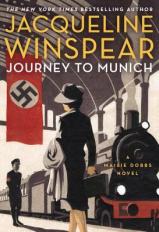 Munich can be an exciting place to visit, full of life and energy. But in 1938 the excitement is not welcome. This is a different Munich, a Munich filled with fear and tension and Brownshirts. Reluctantly, Masie has agreed to accept one more assignment with the British Secret Service. It is a simple assignment. Just go to Munich and escort an English industrialist home by impersonating his daughter so that the Nazis will release him. Oh, and by the way, he has been held in Dachau for two years, but there shouldn’t be any problems.
 It all began when the men went off to war. Alma was one of the few males left in town. He was the teacher in the tiny school, wore an old straw hat and carried his tin case of pencils around, sketching everything. He was also the town’s rat catcher, and with the men gone, he had much to do. He wouldn’t accept payment for his services. Instead, he requested that the women pose for him as he sketched. It was a lovely arrangement, for the women truly enjoyed being drawn, and Alma truly enjoyed drawing. Set in a tiny New Zealand town, this is a gentle, sweet book, full of quirky characters with interesting back stories. Jumping around from the 1940s to the present and in between, it’s about people and relationships. But mostly it’s about painting and painters, about seeing and being seen. I enjoyed it very much. It is suitable for older teens.
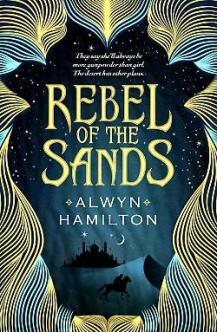 The desert can be a harsh and lawless environment – survival of the fittest. In a country ruled by a Sultan who has allowed foreign armies into its borders, the desert dwellers must be ever alert of the dangers from mortals and djinni. A rebel movement has begun to overthrow the sultan and oust the foreign armies. An ancient magic used to rule the desert but now it seems all are eager to escape the endless sea of sand. After Amani’s mother was hanged for the murder of her husband, Amani lived with her aunt, the oldest wife of a man with many wives. Desperate to escape a fate as his next wife, Amani is intent to find enough money to escape this bleak future and empty town of Dustwalk. She is a sharpshooter and enters a shooting contest hoping to win the prize purse. She meets a foreigner, Jin, with the same steady shooting skill. The two heroes end up fleeing town with soldiers in hot pursuit.
 Hope knew she was adopted at a young age, but that’s about all her mother told her. Many years later, her mother is presumed dead, killed in an earthquake. Hope is sent to Scotland to reunite with her mother’s family and she is in for a shock. It seems her mother is part of a time-travelling family and her mother is not dead but trapped in London 1154 during the reign of Henry II and Eleanor of Aquitane. Hope and her cousins travel back to fetch her mother before the rival time travelling family gets to them and the rare black opal that wields great time travelling power.
 A portrait of 1970 Alaska is vividly portrayed through the eyes of teens, each struggling with very real issues. Ruth feels like the central character because she leads the story. We feel her sense of abandonment because she can remember what it was like to have loving parents. Her sister, Lily, was just an infant so maybe that is why Lily is better adjusted to being raised by their grandmother. Alyce wants to dance and audition for a ballet scholarship but she must spend the summers fishing with her father. Dora is abused by her drunken father but finds safe haven when the family of her best friend, Dumpling, takes her in. Then there are the brothers who stow away aboard a ferry, running to a better life or anything really, until one falls overboard. The poverty, the communal feel of the village, the daily struggles, the cold and icy slush, the feel of the fish camp, and the wild beauty of Alaska, are all so intense. While each teen endures so much, the story culminates in hope, acceptance, and love.
 have tried to select a favorite from these wonderful stories, but I just can’t. At first I chose All the Flavors, loving the open minded child Lily and her adventures with the Chinamen who came to Idaho City. Or perhaps it is The Waves, about a family living on a space ship. Then there is State Change with a woman whose soul is an ice cube. And of course The Paper Menagerie is special.
 The Basque Country in Spain is beautiful and remote. It has its own history, language, and has a strong belief in its mythology. Inspector Amaia Salazar grew up there, so she was the logical one to be assigned to head the investigation. Two young girls had been found murdered and their bodies seemed to be arranged in some pagan purification rite. There were animal hairs and tracks around the bodies, so the press, always looking for the sensational, suggested that the murderer was a basajaun, the mythical beast that roamed the hills. Amaia had left her home years ago and hoped never to go back, for her childhood was traumatic and her nights were still filled with nightmares. She was a rational woman, trained by the FBI and married to an American sculptor, but in her home town she found herself surrounded by superstition and found herself being sucked into the myth.
 As a Venetian police inspector, Guido Brunetti was called upon to investigate all manner of crimes, but when his mother-in-law’s best friend asked for a favor, Brunetti needed to find a gentle way to decline.
 He is an outcast – misshapen, unloved, fearful. He keeps to himself. It is safer that way. Acting on impulse (a very rare thing) he adopts an aggressive one-eyed dog. And so, his life begins to change. He has a friend. When his friend is threatened, they run, leave home, live in the car.
 Solara has spent most of her life in an orphanage and has learned to fend for herself. It’s not been an easy life and she is now a convicted felon trying to get passage to the outer planets. She’s able to hire herself a spot on a flight as an indentured servant to former classmate Doran, an arrogant boy born of priveledge. The tables turn a bit and Solara manages to make Doran her servant when they gain passage on a junker heading to the outer planets. Each member of the sparse crew has something to hide but seem to have good hearts. One adventure after another involving space pirates, fights, theft, and mystery along with a touch of romance makes this light science fiction romp pure fun. Great characters, fun plot and adventure, adventure, adventure!
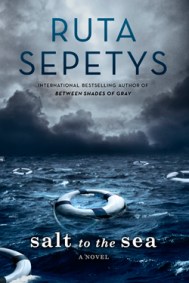 During the close of WWII, Europeans were frantically trying to get out of the way of the advancing Russian troops. Rape, pillage, torture. Masses were making their way north to the Baltic Sea to board the evacuation ships. A former cruise ship, the Wilhelm Gustloff was refitted to transport thousands of evacuees, civilians and troops. The story is told in the multiple voices of the small group that bands together for the journey. A young Polish girl, a nurse, a shoemaker, a small boy, a brusk woman, a blind girl, a young German with a mysterious past. They come from different backgrounds, different countries and must rely on each other to complete the journey. The horrors of war they endure and the desperate attempt to make it onto a ship. A ship to depart with 10,000 passengers. A ship that would be targeted by Russian torpedoes. The sinking of the Wilhelm Gustoff is the largest maritime disaster in history.
 What if women were included in the armed forces during World War II? This is the premise behind this vivid portrayal of army life during WWII. The first part of the book focuses on several women and what led them to enlist in the military. Rio is currently the main star of the story, changing from farm girl to sharp shooter. The cast of characters come together during a battle in North Africa, based on events of the battle that really occurred. The result is a gritty, bloody realistic depiction of war.
 Henry Lytten, an Oxford don, is writing a fantasy novel. As he writes, his gentle pastoral world emerges. Meanwhile a few hundred years in the future, Angela Meerson has discovered a portal to another world and uses it. Thus, the two lives become connected with interesting consequences.
 Small pieces of paper fluttered down on the people massed in the piazza before the Sistine Chapel. Twelve-year-old Lucrezia heard her aunt read one aloud “We have for our Pope, Cardinal Rodrigo Borgia of Valencia, known as Alexander Sixth”. Lucrezia wanted to laugh aloud, for Papa had triumphed. Lucrezia Borgia . . . the name personifies evil; a seductive woman who schemed and poisoned her way through life. But this novel presents a different woman. Yes, she is the daughter of a Pope, and yes she is self-centered. But she emerges as a young woman whose only value was as a pawn in negotiations, a young woman whose happiness was never considered, a young woman determined to survive in spite of every obstacle.
 YA Lit Ramblings
You must be logged in to post a comment.